Chubb VRIO Analysis

  • Report

  • ID: 531439
  • 10 Pages
  • May 2025
  • Region: North America
Report Menu

Model Overview

About Chubb

Chubb is the world’s largest publicly traded property and casualty (P&C) insurer. Chubb has established its global presence with local operations in 54 countries and territories. Chubb Limited, the Swiss-incorporated holding company of the Chubb Group of Companies, and its direct and indirect subsidiaries is headquartered in Zurich, Switzerland.Chubb Limited, the parent company, is listed on the New York Stock Exchange (NYSE: CB) and is a component of the S&P 500 index. As of early 2023, Chubb employed over 31,000 people.

VRIO Analysis Model

The VRIO framework is an essential strategic tool for evaluating Chubb resources and capabilities, providing insights into how these can be leveraged to maintain a competitive advantage.

VRIO analysis explained: The VRIO framework is used to assess the resources and capabilities of Chubb through four key dimensions: Value, Rarity, Imitability, and Organization. This method helps identify which assets offer a sustainable competitive advantage and which may require further enhancement. By focusing on assets that meet the four VRIO dimensions, Chubb can channel efforts and investments toward improving its competitive positioning. The VRIO approach is part of the broader Resource-based view (RBV model) that underscores the importance of internal strengths in strategic management frameworks which can be integrated into corporate strategy frameworks.

Listed below are the four key dimensions of the VRIO framework, each critical for assessing the company's resources:

  1. Value
    Does the resource or capability add significant value to the business? Valuable resources enhance efficiency or effectiveness, contributing to cost savings or creating differentiation in the market.
  2. Rarity
    Is the resource uncommon or unique among competitors? Rare resources are held by only a few companies, making them hard for others to replicate or obtain.
  3. Imitability
    Is the resource challenging or costly for competitors to duplicate? The greater the difficulty or expense involved in imitating the resource, the more likely it is to provide a sustained competitive advantage.
  4. Organization
    Is the company structured to maximize the use of the resource or capability? For a resource to offer a sustainable competitive advantage, the business must have the appropriate structure, policies, and processes in place to fully leverage it.

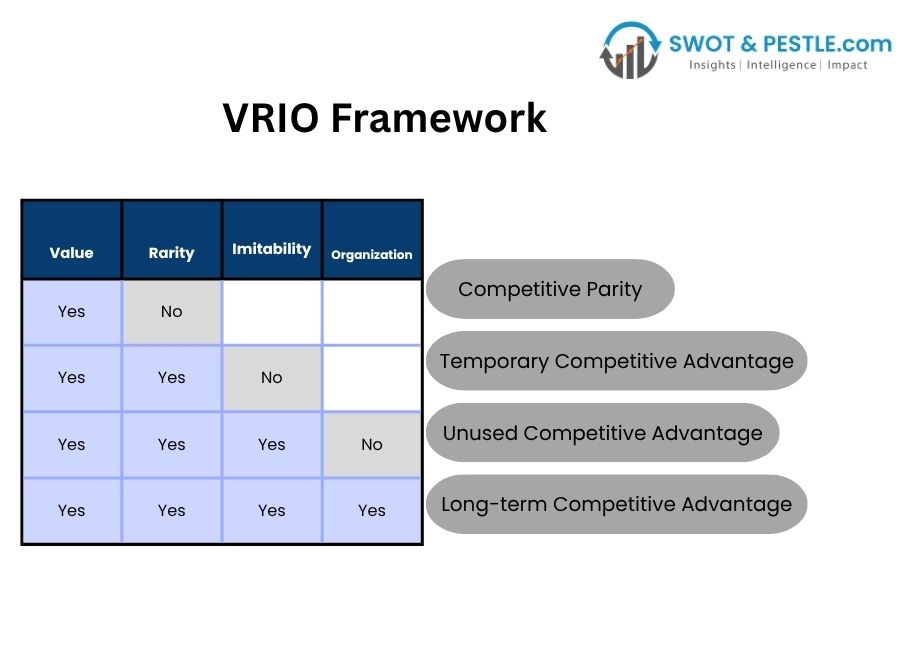
VRIO Framework Diagram Illustrating Market Forces for Chubb

The VRIO framework diagram below illustrates how resources are aligned with the 4 VRIO dimensions, showcasing areas of strength and potential opportunities for strategic enhancement. This visual representation highlights how internal analysis in strategic management can contribute to sustaining a competitive position in the industry. 

(The paid VRIO Analysis report for Chubb will provide this diagram customised for Chubb with actual parameters evaluated against the 4 VRIO dimensions)

VRIO Analysis for Chubb Explained:

In the competitive insurance industry, understanding the internal strengths of a company like Chubb is crucial for sustaining long-term success.

Applying the VRIO analysis offers several strategic benefits for Chubb
  • Strategic Resource Allocation: The VRIO analysis template aids in identifying which resources should be prioritized for investment. The company can allocate resources more effectively to drive growth and innovation by determining valuable, rare, and difficult-to-imitate assets.
  • Optimizing Competitive Advantages: VRIO analysis for business strategy helps businesses optimize their competitive advantages by highlighting how well their resources are organized and utilized. This allows Chubb to refine its strategies to leverage these advantages in the market better.
  • Enhancing Operational Efficiency: Understanding the VRIO analysis in business can reveal insights into how effectively internal processes support the use of resources. This can improve operational efficiency and effectiveness, ensuring that these assets contribute maximally to business goals.
  • Guiding Strategic Initiatives: Through VRIO framework analysis, the insurance giant can identify key resources that are critical for strategic initiatives. This guidance supports decision-making processes, helping the firm develop and implement strategies that align with its strengths and market opportunities.
  • Benchmarking Performance: By employing VRIO analysis examples for companies, Chubb can benchmark its performance against competitors. This comparison helps assess where it stands concerning industry standards and identify areas for potential improvement.
  • Identifying Competitive Disadvantages: Utilizing the VRIO strategic tool, Chubb can pinpoint resources that may not add significant value to its operations. By analyzing business resources with VRIO, it can identify potential competitive disadvantages, essential for understanding the highly competitive insurance industry.
  • Maintaining Competitive Parity: In cases where Chubb resources are valuable but not rare, the VRIO framework in strategic planning indicates that the company may achieve competitive parity, especially within the insurance industry. This scenario, where it remains on par with its rivals, is common when resources are widely accessible.
  • Gaining Temporary Competitive Advantage: Resources that are valuable and rare, but easily imitated, provide one with a temporary competitive edge. By understanding VRIO analysis in strategic decision-making, one can leverage these resources for short-term gains while preparing for long-term strategies.
  • Achieving Sustained Competitive Advantage: For resources that are valuable, rare, hard to imitate, and well-organized, the VRIO framework ensures that Chubb achieves a sustained competitive advantage. This is a key outcome in competitive advantage frameworks, where internal strengths are optimized.
  • Enhancing Organizational Effectiveness: A critical aspect of the analysis for companies is how it evaluates the ability to utilize the resources effectively. When Chubb is well-organized to exploit its resources, internal analysis in strategic management shows that the company can significantly improve performance. Comparing VRIO vs. Porter’s Five Forces also offers insights into how internal organization plays a vital role in maintaining a competitive position in the market.

Table of Contents

  • Chubb Overview
    • 1.1 About the company
    • 1.2 Business Sector
    • 1.3 Operating Geography
    • 1.4 Revenue
  • VRIO Framework Overview
    • 2.1 What is it about?
  • Benefits of VRIO Analysis
    • 3.1 What are the benefits of VRIO analysis?
  • Detailed VRIO Analysis for Chubb
    • 4.1 Resource 1 evaluation on VRIO framework
    • 4.2 Resource 2 evaluation on VRIO framework
    • 4.3 Resource 3 evaluation on VRIO framework
    • 4.4 Resource 4 evaluation on VRIO framework
    • 4.5 Resource 5 evaluation on VRIO framework
    • 4.5 VRIO framework diagram illustrating the market forces for Chubb
  • Conclusion
    • 5.1 Closing thoughts
  • References & Methodology
    • 6.1 References used to prepare this report
    • 6.2 Methodology used to prepare this report

    References and Copyright

    Expand all

Why Choose Us?

why us

Delivery Within * 1 Business Day


Live chat