Nike, Inc. is a global leader in athletic footwear, apparel, equipment, and lifestyle products, widely recognized as one of the most influential brands in sports and fashion. Headquartered in Beaverton, Oregon, United States, the company has built a vast global presence since its founding in 1964 as Blue Ribbon Sports before officially becoming Nike, Inc. in 1971. Nike continues to dominate the global sportswear industry through its strong brand identity, extensive distribution channels, and relentless focus on product innovation, performance technology, and consumer engagement.In 2025, Nike maintains its leadership by pushing boundaries in digital transformation, sustainability, and direct-to-consumer growth.
STP Analysis Model
STP Analysis—which stands for Segmentation, Targeting, and Positioning—is a critical framework in marketing that allows companies like Nike Inc. to focus on their most valuable customers by identifying distinct market segments, selecting the appropriate target markets, and positioning their products in way that aligns with consumer needs and preferences. This approach is essential for a global brand, enabling it to craft tailored marketing strategies that enhance customer engagement and drive brand loyalty.

By employing the STP Marketing Strategy, Nike Inc. can navigate the complexities of diverse markets, offering products that meet specific customer demands. The STP Framework provides a systematic marketing approach, ensuring that Nike Inc. meets and exceeds consumer expectations by focusing on what matters most to different market segments. Implementing the STP Model in Marketing is crucial for staying competitive and achieving sustained business growth.

Building on this foundation, the following sections delve into each component of the STP Analysis, offering a comprehensive exploration of how it informs marketing strategies and fosters brand success.
Segmentation Market segmentation involves dividing a broad market into distinct subsets of consumers with common characteristics, such as demographics, psychographics, or behaviour. Companies like Nike Inc. using advanced Market Segmentation Techniques allow them to tailor their products and marketing efforts to meet the specific needs of different customer groups. This strategic approach is vital for aligning the company's offerings with consumer demands, thus maximizing market opportunities. More effective targeting and positioning strategies emerge when segmentation is approached with precision.

Targeting After segmentation, the Target Market Selection process involves identifying the most lucrative market segments and focusing on them with tailored marketing strategies. For businesses, this means directing resources to segments with the highest growth potential, ensuring that the marketing investments yield the best returns. The STP strategy for business growth enables one to create personalized marketing campaigns that resonate with the chosen target audiences, fostering stronger customer relationships and boosting sales.

Positioning Positioning is the strategic effort to establish a unique and compelling place for Nike Inc.'s products or services in the minds of target consumers. Through Positioning Strategies in Marketing, it can differentiate itself from competitors by emphasizing the unique value and benefits of its offerings. This differentiation is critical in a competitive marketplace, helping the company to stand out and maintain its market leadership. The STP framework for marketing success ensures that its brand message is clear, consistent, and aligned with consumer expectations.

Positioning Strategies:
By Product Features: Focusing on the distinct characteristics or advantages of a product.
By Price and Quality: Showcasing either cost-effectiveness or high-end quality.
By Usage or Occasion: Linking the product to particular uses or events.
By Competitor Comparison: Distinguishing the product from rivals by emphasizing its superior qualities.
By Lifestyle Alignment: Connecting the product to the values, beliefs, or lifestyles of the target market.
Example: Apple positions itself as a leader in technology that combines sleek design with user-friendly functionality, while Patagonia emphasizes its commitment to environmental sustainability and ethical production practices.

STP Analysis Process:
Identify Market Segments: Segment the broader market using criteria such as demographics, geography, psychographics, and behaviour.
Assess Segment Attractiveness: Assess each segment's market size, growth potential, competition, and alignment with company objectives.
Identify Target Segments: Choose the most promising segments based on profitability, competitiveness, and business alignment.
Develop Positioning Strategy: Create a clear positioning statement highlighting the product's unique value for the selected target segments.
Implement Marketing Mix (4Ps): Adjust Product, Price, Place, and Promotion strategies to align with the target segment and positioning.
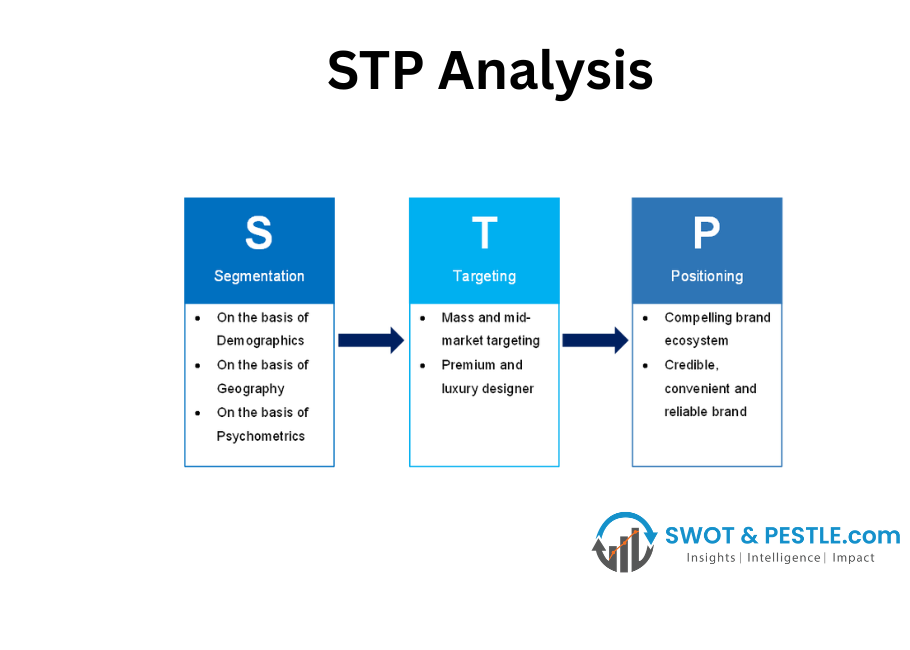
STP Analysis Diagram Illustrating the Market Forces for Nike Inc.

A customized STP Analysis Diagram can visually represent the process of segmentation, targeting, and positioning for Nike Inc.. This diagram illustrates how the company identifies key market segments, selects its target audience, and positions its offerings to meet these consumers' needs effectively. This visual tool is essential for strategic decision-making, helping Nike Inc. navigate diverse markets' complexities.

(The paid STP Analysis report for Nike Inc. will feature a customized diagram, showcasing the segmentation, targeting, and positioning strategies tailored for Nike Inc..)
STP Analysis for
Nike Inc. Explained:
In the competitive sports apparel and accessories industry, leveraging the STP Analysis (Segmentation, Targeting, and Positioning) is essential for a company like Nike Inc. to effectively connect with its most valuable customers. Adopting this framework provides several strategic advantages for Nike Inc.:
Enhanced Market Segmentation: The STP Analysis in Marketing allows Nike Inc. to precisely identify and target specific market segments. By leveraging the STP Marketing Model, it can tailor its product offerings to meet the unique needs of each segment, leading to more effective marketing strategies and higher conversion rates. This precise segmentation helps in aligning products with consumer demands, ensuring that marketing efforts are both efficient and impactful.
Optimized Targeting Strategies: Through the Target Market Selection Process, one can focus its resources on the most promising market segments. This strategic approach not only maximizes return on investment but also helps in building stronger relationships with target customers. By implementing the STP Strategy for Business Growth, it can design marketing campaigns that resonate with the target audience, driving customer loyalty and increasing market share.
Stronger Brand Positioning: The STP Framework enables Nike Inc. to position its products in a way that differentiates them from competitors. By focusing on the unique value propositions of its offerings, it can strengthen its brand image and appeal to its target market. This differentiation is crucial in maintaining a competitive edge, especially in saturated markets. The STP Analysis for Market Segmentation ensures that the company’s products stand out, leading to enhanced brand recognition and customer preference.
Improved Customer Satisfaction: By aligning its products with the specific needs of targeted segments, Nike Inc. can improve customer satisfaction, leading to higher customer retention and loyalty. The STP Framework for Marketing Success ensures that it meets and exceeds customer expectations, creating a positive brand experience that drives repeat business. This focus on customer satisfaction is key to building long-term relationships and sustaining business growth.
Strategic Business Growth: The STP Strategy for Business Growth supports businesses in expanding their market presence and entering new markets with confidence. By strategically targeting and positioning its products, one can capture new customer segments and drive business expansion. This approach not only increases market share but also helps in achieving sustained growth in a competitive landscape. The STP Analysis in Digital Marketing further enables it to leverage online platforms for targeted marketing, enhancing its reach and impact in the digital space.
Customer-Centric Marketing: Adopting a Segmentation Targeting Positioning (STP) Marketing Strategy empowers businesses to gain deeper insights into customer needs and preferences. This leads to the development of more personalized and relevant marketing strategies. By understanding what drives their target audience, companies can create tailored messaging and offerings that resonate with consumers, ultimately enhancing customer engagement and satisfaction. This approach is particularly effective in competitive markets where understanding consumer behaviour is key.
Resource Efficiency: By concentrating efforts on the most promising market segments identified through STP Analysis, companies can optimize their resource allocation and marketing expenditures. This strategic focus allows businesses to streamline operations, minimize waste, and invest in initiatives that deliver the highest return on investment. In doing so, companies can enhance their STP process, improving overall operational efficiency while driving business growth.
Competitive Advantage: A well-executed STP Framework serves to distinguish a product from its competitors, fostering a unique brand identity in the marketplace. By effectively communicating the distinct value and benefits of their offerings, companies can establish a competitive edge that enhances brand loyalty. This strategic positioning is essential for attracting new customers who align with their brand values, making it a critical component of any successful STP analysis in marketing.
Table of Contents
Nike Inc. Overview
1.1 About the company
1.2 Business Sector
1.3 Operating Geography
1.4 Revenue
Segmentation, Targeting and Positioning Analysis Overview
2.1 What is it about?
Benefits of STP Analysis
3.1 What are the benefits of STP analysis?
Detailed STP Analysis for Nike Inc.
4.1 Segmentation
4.2 Targeting
4.3 Positioning
4.4 STP analysis diagram illustrating the market forces for Nike Inc.
You can use the following in your reference section to
give credit to the source. For different referencing
styles and detailed guidelines, please
click here
Nike Inc. analysis has been conducted and reviewed by senior analysts from Barakaat Consulting.
Copyright of Nike Inc. Analysis is the property of Barakaat Consulting. Please refer to the Terms and Conditions and Disclaimer for usage guidelines.
The reports published by SWOT & PESTLE.com are created under a stringent life cycle which undergoes data validation checks and quality surveillance at each of the stages of data procurement, identification, selection, processing, extraction and analysis. Earnest efforts are made to capture and validate the quality and preciseness of data. Our analysts by and large use the following sources to put together valuable analytical research reports:
Company annual reports and SEC filings (10-K, 20-F, 10-Q etc)
Company official portal
Investors presentations
Research reports of key industry players/competitors
Historical data
Data from government sources
Media releases which include journals, published literature, press releases, market information that cover industry news, country news, and customer intentions.
An aggregation of the experiences, expertise and insights of our analysts who go through volumes of data to extract meaningful information.
Why Choose Us?
Other Analysis
Related Report
Recently Viewed
Delivery Within * 1 Business Day
This report contains the table contents only. In case you
need the complete report please purchase using the buy
options displayed.
This is the sample complete report which will give you a
glimpse of what your complete report will cover after
purchase.
Get the report (PDF) delivered to your email.
** Get the report (PDF) sent to your email within
minutes
The illustrative sample reports are shared in order to give
you an idea of what the STP Analysis Report for Nike Inc. will cover
after purchase. We invest deep in order to bring you
insightful research which can add tangible value to your
business or academic goals, at affordable pricing.
Value Subscription Plans
Subcription Plans start with as low as $53
Custom Research Reports
Are you looking for a report which is customised to
align with your business needs?
Our custom research services provide incisive
competitive acuity you need to dig In to the right data
and provide actionable insights decisions for your
business.
Our experienced analysts and
consultants will ensure comprehensive coverage and
tailor it to best fit your needs.
Please note that custom research reports have a
delivery period anywhere between
1 to 5 business days.
Delivery Within * 1 Business Day
Nike Inc. STP Analysis
In case you want this report emailed straight into your email
inbox, kindly share your details below. Please note that you agree
to receive email updates from us on our new reports and solutions.